
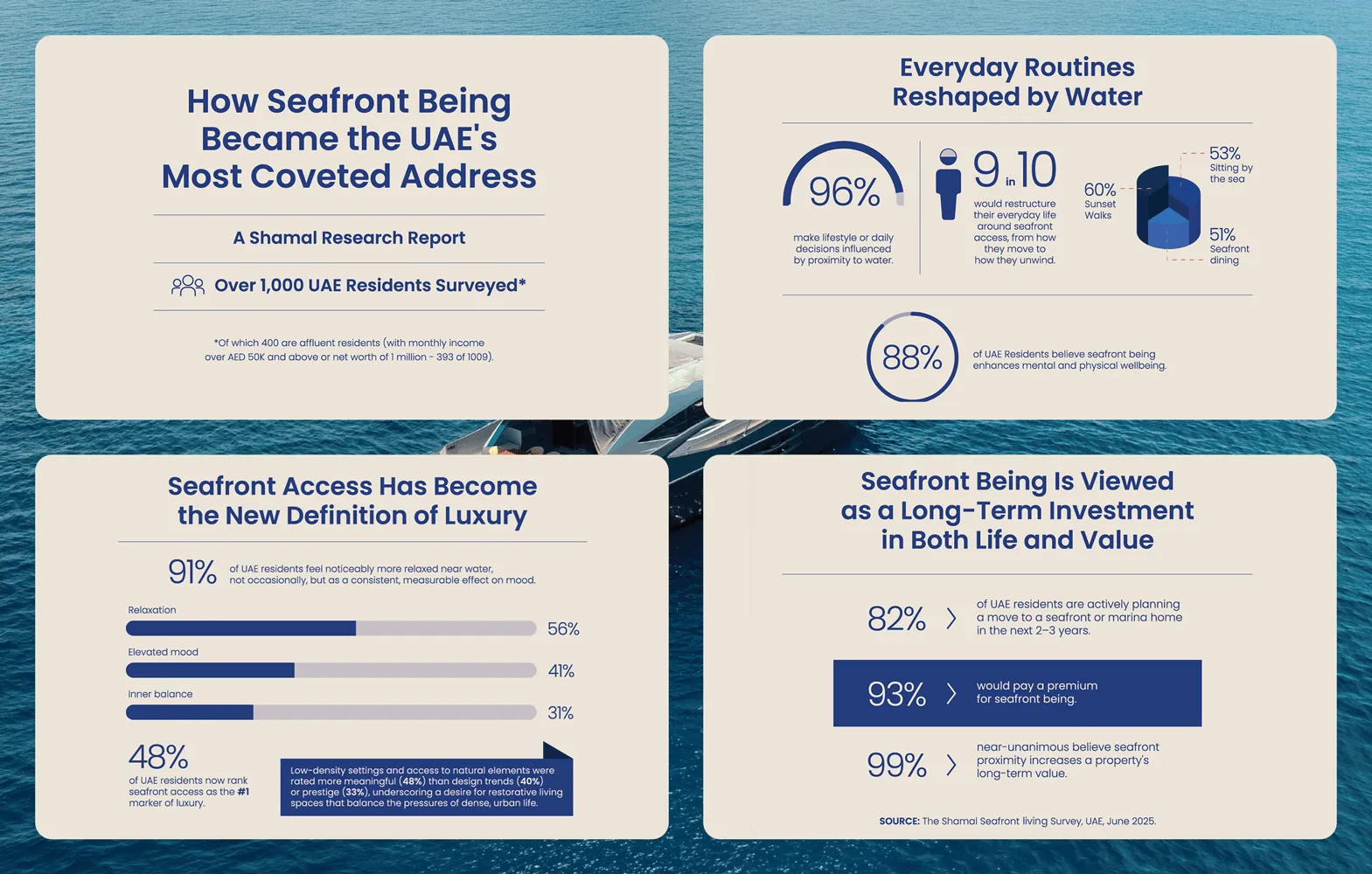
- 96% of respondents stated that daily decisions are influenced by proximity to water, including travel, exercise and stress management
- 82% of respondents in the study are considering moving to seafront or marina living within the next two to three years
- The initiative supports the wider public conversation around quality of life, future communities and human-centred destination design.
- Research data, expert perspectives have been combined in an Industry White Paper as part of Shamal’s thought leadership initiative – The Future of Seafront Being
- Findings provide evidence that the city's long-term vision closely reflects evolving resident aspirations
Shamal Holding, the diversified investment company, reveals new data on consumer aspirations on seafront lifestyle and real estate, commissioned with YouGov among 1,009 UAE residents. The data, unpacked through a panel of industry experts and a white paper, is part of Shamal’s thought leadership initiative: The Future of Seafront Being. The multi-dimensional initiative contributes to Dubai’s wider industry conversation and reinforces directions set by the Dubai Quality of Life Strategy 2033 and the Dubai 2040 Urban Master Plan. The research findings provide a practical evidence base for the broader industry as it considers how Dubai’s communities should evolve, while also informing Shamal’s long-term destination strategy.
A clear finding emerges from the research: proximity to water is no longer simply an aesthetic preference or a luxury real estate attribute. It is increasingly shaping how residents structure their days, manage their wellbeing and build stronger social connections — proof that seafront living is now understood in human terms, not just design terms.
The data from Future of Seafront Being bridge policy, people and place. They align with key Dubai Strategies which place emphasis on wellbeing, access to nature, walkability and high-quality public spaces. It also supports the broader competitiveness agenda reflected in Dubai Economic Agenda D33, where quality of life is increasingly central to how cities attract people, investment and long-term value.
For Shamal, the initiative reflects a long-held belief that exceptional destinations begin with a deep understanding of the people they are created for. The research enables decision-making, strategic planning and in exploring new opportunities in design, focusing on how people want to live, not only on what they buy. Additionally, the Future of Seafront Being is intended to support thinking on urban planning and destination design in Dubai and beyond.
Abdulla Binhabtoor, Chief Executive Officer, Shamal Holding said: “In Dubai, our relationship with the sea has always shaped our identity and ambition. We believe that Seafront Being is the evolution of seafront living, from simply residing by the water to experiencing the waterfront as an integrated part of daily life, work, leisure, wellbeing and belonging. At Shamal, we see this as a responsibility of design, not a benefit of position.”
He added: “With Dubai’s advancement as a city centered around quality of life, there is a necessity to generate the evidence that informs it. That means investing in research and expert dialogue, listening carefully and testing our assumptions. As prime coastal land becomes increasingly scarce, our focus remains on creating places that enrich lives today and endure for generations to come. The Future of Seafront Being is our contribution to a much larger conversation, about how Dubai, and cities everywhere, can be shaped around how people actually want to live.”
Salient data points from the UAE Residents Survey by YouGov:
Water as a Daily Anchor:
- 96% of respondents make daily decisions influenced by proximity to water, spanning travel choices, exercise routines and stress management.
- Almost nine in ten (88%) said they would adapt their physical wellbeing routines if they had regular access to seafront walkways, marinas or sea views at home.
- The most common habits associated with seafront access are walking at sunset (60%), sitting by marinas (53%), and leisure or dining by the beach (51%), simple, frequent rituals that residents associate with calm, connection and recovery.
- The belief in water's benefit runs deeper still as 88% of respondents say living by the seaside meaningfully enhances both their mental and physical wellbeing.
A Defining Shift in Lifestyle Aspiration
- 82% of respondents are considering a move to seafront or marina living within the next two to three years; the research confirms that proximity to water is reshaping both lifestyle aspirations and investment priorities.
- Coastal and marina environments are preferred by 45% of respondents, outperforming high-density urban settings, with quieter, nature-integrated communities valued over prestige or design trends.
- The research also signals long-term confidence in this shift, whereby 93% of respondents would pay a premium for homes that are on the seafront.
- Furthermore, 99% believe proximity to water increases a property's long-term value, underscoring the importance of the data for investors, developers and planners.
The Emotional Value of Blue Spaces
- 91% of respondents said they feel more relaxed near water, not just occasionally, but as a consistent, measurable effect on mood, with one-in-three describing this as a deep sense of emotional calm.
- Respondents associate seafront access with relaxation (56%), quiet space (41%), uplifting emotion (41%), a stronger connection to nature (33%) and inner balance (31%).
- The data also points to a redefinition of luxury itself, driven by 48% of respondents ranking meaningful, nature-connected living as the top marker of a desirable home, ahead of design trends (40%) and social prestige (33%)
Taken together, the findings position seafront destinations as more than lifestyle assets. They show how blue spaces can support daily wellbeing, stronger community connection and long-term urban value. In a fast-growing city, the research reinforces the opportunity for public and private sector players to prioritise connected, walkable and restorative environments.
The research findings and expert perspectives are captured in The Future of Seafront Being White Paper. The paper explores how seafront destination design can support healthier, happier and more connected communities, directly reinforcing Dubai's long-term vision, as the city continues to shape the next generation of urban living.
As cities compete increasingly on the quality of everyday life they offer, Shamal aims to contribute to this conversation through research, destination design and long-term investment.
Download the The Future of Seafront Being White Paper

